
Meshtastic is an open-source firmware that turns a 30 dollar LoRa radio module into a long-range, off-grid, encrypted text and position node. There is no SIM card, no monthly fee, no internet, and no cell tower. Two nodes can talk directly across roughly 5 to 15 kilometers of line-of-sight terrain, and a chain of nodes can relay messages dozens of kilometers further. For RV travelers crossing dead zones in Iberia or Eastern Europe, hikers spread out along an exposed ridge, or anyone who has ever lost a friend in a parking lot in the Algarve, Meshtastic is the most useful piece of communication kit to come out of the maker community in years.
This is a practical guide to what Meshtastic is, what it isn't, which hardware to buy, and how to actually use it on the road and in the mountains.
What Meshtastic Is
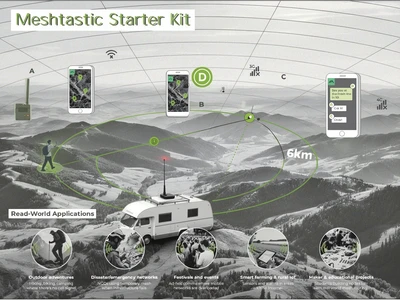
You interact with a node from your phone over Bluetooth, using the Meshtastic Android or iOS app. The app handles text messaging (one-to-one or group channels), live position sharing on a map, telemetry from sensors attached to the node (temperature, battery, GPS), and node discovery. AES-256 encryption is enabled by default per channel; only nodes that share the channel key can read each other's traffic.
What Meshtastic Isn't
Three things to set expectations:
- Not a phone. Bandwidth is tiny, on the order of hundreds of bytes per second on the slowest reliable preset. Text messages and short location pings only. No voice, no images, no streaming.
- Not a satellite messenger. Garmin inReach and Apple Emergency SOS reach actual satellites. Meshtastic only works between nearby Meshtastic nodes. If there is nobody else in range and no relay infrastructure, you have a brick.
- Not real-time. Messages can take seconds or even tens of seconds to propagate through a multi-hop mesh, especially on the longer-range, slower presets. Treat it like SMS on a slow network, not like instant chat.
Hardware: What To Actually Buy
The hardware ecosystem can be confusing because there are dozens of compatible boards. Three categories cover almost every use case for travelers:
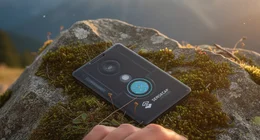
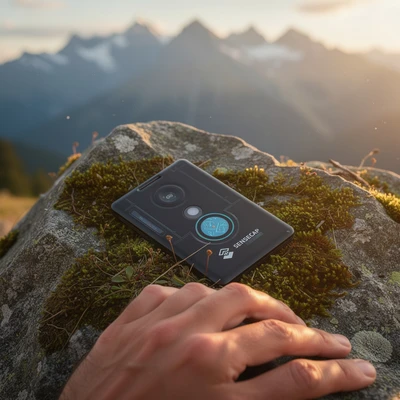
Pocket Tracker (SenseCAP Card Tracker T1000-E)
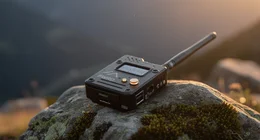
Maker Tracker With Display (Wio Tracker L1-Pro)
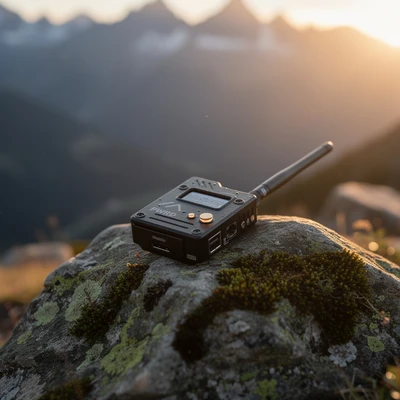
Compared to the card-shaped T1000-E, the L1-Pro is the better choice for users who want feedback on the device itself (display always shows mesh status, last received message, current GPS lock, battery level) and for tinkerers who plan to mod the firmware or attach external sensors. It is meaningfully more expensive than the T1000-E but still under 100 EUR. As always, confirm the regional frequency variant matches your destination (EU 868 MHz, US 915 MHz) before ordering.
Vehicle and Base Nodes (Heltec V3, RAK4631)
For an RV, a fixed base node works better than a pocket device. The Heltec V3 ESP32 board is the cheapest option (around 20 EUR), with an 0.96-inch OLED for status and a USB-C jack for power. Wire it to a 12 V step-down converter on your house battery, run a coaxial cable to a roof-mounted 868 MHz antenna, and it sits there silently as a relay and tracker for the whole rig. The RAK4631 (around 35 EUR) is the premium upgrade with longer battery life and better range; pair it with a RAK Wisblock baseboard for a clean enclosed build.
Solar Repeaters
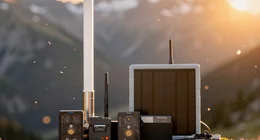
For multi-day group hikes or convoys spread across larger terrain, a small solar-powered relay can be left on a high point to extend the mesh. They run indefinitely on sun and forward traffic for any node that connects. Two practical options stand out: a DIY build around a LILYGO T-Beam Supreme or RAK Meshtastic Solar Mini with a 5 W panel (typically 80 to 120 EUR all-in), or the much easier path of buying a fully-integrated outdoor unit.
SenseCAP Solar Node P1 (Seeed Studio)
The Seeed Studio SenseCAP Solar Node P1 for Meshtastic LoRa is the closest thing to a "drop it and forget it" Meshtastic relay you can buy. It is a fully-integrated, IP-rated outdoor unit: solar panel, weatherproof enclosure, internal battery, LoRa antenna, and pre-flashed Meshtastic firmware in a single piece of hardware. There is nothing to wire, nothing to solder, and nothing to recharge. You strap it to a fence post or a roof rack, point the panel south, and it shows up on the mesh.
For travelers who want a permanent relay node on the camper roof, or a portable repeater to drop on a hilltop above a hiking base camp, the P1 saves an evening of soldering and 3D-printed enclosure work. It is the "buy once, deploy forever" option in the lineup. Confirm the regional frequency variant matches your destination (EU 868 MHz, US 915 MHz) before ordering.
Whatever you buy, double-check the radio frequency before ordering. EU sellers often list both 433 MHz and 868 MHz versions; in Europe you want 868 MHz. North American buyers want 915 MHz. The wrong frequency is unlawful to operate and won't talk to nodes on the correct band anyway.
Use Case: RV Convoys
The most immediate use for nomads on wheels is convoy tracking. Two RVs traveling together through the Picos de Europa or the Tatras can drop in and out of cell coverage hourly. With a Meshtastic node bolted in each rig:
- Both vehicles see each other's live position on the app, updated every minute or two.
- Either driver can ping the other ("pulling over for fuel", "found a spot for tonight at coords") without needing reception.
- If one rig breaks down, the other has the precise GPS of the breakdown the moment it stops moving.
Range expectations on flat ground are honest: roughly 5 to 8 km between vehicles. In hilly or forested terrain it drops to 1 to 3 km. With a roof-mounted external antenna the typical range climbs by a factor of 2 to 4. For convoys that genuinely travel out of line-of-sight, drop a third node (a SenseCAP P1 on a hilltop, or a static base node at the meeting-point campground) to bridge the gap.
Use Case: Hiking and Day Trips
For a hiking group spread out along a long climb, every member carries a pocket tracker. The leader can see who is where on a single map screen, and anyone can send "running 20 minutes late" or "turned back at the saddle" without yelling across switchbacks. On a multi-day traverse, leave a solar repeater at the base camp and the whole group keeps mesh contact for the duration of the trip.
For solo hikers in a region with active community Meshtastic infrastructure, a single node can act as a dead-man's-switch backup: if your battery dies or you stop moving for too long, your last known position is on the network for friends or family to retrieve. This is not a substitute for a real PLB or satellite messenger if your hike is genuinely remote, but for backcountry where there is decent mesh coverage (parts of the Alps, increasingly the Pyrenees, the BeBoP network in northern Germany), it is a useful additional layer.
Use Case: Securing the Camper with Door Sensors
One of the most useful and least obvious applications of a Meshtastic mesh is camper security. Every camper has a habit of getting left alone for hours: while you are off hiking, in town doing groceries, or eating dinner three campsites over. Cellular alarm systems work, but only when the camper is parked somewhere with cell coverage, which is exactly where most off-grid travelers are not. A Meshtastic-bridged door sensor solves this end to end without any external infrastructure.
The cheap end of the 433 MHz wireless sensor market (KERUI, Sonoff, generic Aliexpress door switches) sells magnetic door and window sensors for under 10 EUR each. They run for years on a single coin cell and broadcast a fixed code every time the door opens or closes. Until now those codes have only been useful with a 433 MHz home-automation hub. The open-source meshtastic-gate-sensor project bridges those signals straight onto the Meshtastic mesh.
The architecture is simple: a 433 MHz receiver decodes the sensor's code with an Arduino Nano, the Nano forwards a short text line over a logic-level-shifted serial link to a Heltec LoRa32 V3 running stock Meshtastic, and the Heltec relays the line into the mesh as a normal text message. Open the camper door and "Gate: TRIGGERED" arrives on your handheld node anywhere within mesh range, typically the entire campground and a long way beyond. The board also broadcasts a "GATE NODE: Online" heartbeat every 5 minutes so you know the sensor is still alive.
The full BOM comes in around 52 USD, the carrier board is a 75 by 66 mm two-layer PCB you can order from JLCPCB, and the firmware ships with a "learn-sensor" mode that auto-discovers the code of any 433 MHz sensor you happen to find. Power is a Waveshare Solar Power Manager D with two 18650 cells and a 6 W solar panel; total draw is about 105 mA, which the panel covers indefinitely. The license is ISC.
The intended use is exactly what RV travelers want: a small solar-powered enclosure that lives somewhere out of sight on the camper, with a 10-EUR magnetic sensor on the door. Walk away with your handheld node in your pocket and you get a notification within a few seconds of any door opening, anywhere there is mesh coverage. No cell, no WiFi, no cloud account, no monthly fee. The same architecture extends to window sensors, the storage compartment, the gas locker, or any other point you want to monitor.
Setup In Practice
Out of the box, a flashed Meshtastic device is online in about ten minutes:
- Install the Meshtastic app on your phone (Android or iOS).
- Charge the node and turn it on.
- Pair the node with the app over Bluetooth (a six-digit code shows on the OLED).
- Set your region (EU_868 in Europe) and a node name.
- Create or join a channel: paste a channel URL or QR code from another node into the app, and you are on the same encrypted channel as the rest of your group.
The default LongFast preset is the right starting point: about 1.7 kbps throughput, decent range, supported by basically every node you will encounter in the wild. Switch to LongSlow only if you need maximum range and your messages are not time-sensitive.
Battery Life and Power Tuning
A SenseCAP T1000-E in default tracking mode runs about 3 to 5 days on the internal battery with GPS active and broadcasting position every 15 minutes. Drop the position interval to once an hour and the same battery lasts a week or more. For RV base nodes powered from the house battery, draw is negligible (under 100 mA continuous), so the practical limit is just antenna placement and hardware quality. The SenseCAP Solar Node P1 and the meshtastic-gate-sensor build run continuously on solar power alone in any reasonably sunny climate.
Privacy and Encryption
All traffic on a Meshtastic channel is encrypted with AES-256 using the channel's PSK. Anyone with a Meshtastic node and the channel URL can join, and anyone without it sees only encrypted noise. The default public LongFast channel uses a published key, so if you want privacy from random hobbyists in the area (a real consideration in cities and along busy travel corridors), set up a private channel with a freshly generated key and share its URL only with your group. Any door-sensor traffic obviously belongs on a private channel, not on LongFast.
Position broadcasts can be set to "precise", "approximate" (rounded to a few hundred meters), or off entirely on a per-node basis, in case you want to be reachable but not trackable.
Bundle Option: SenseCAP Meshtastic Starter Kit
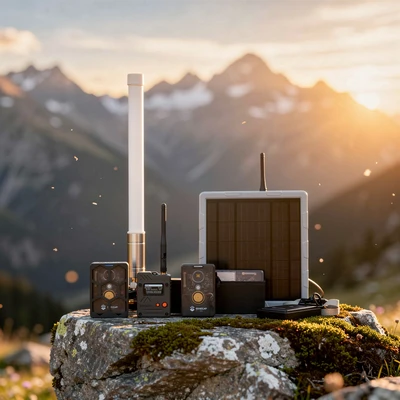
The kit is built around the use case most RV travelers actually want. The Solar Node P1 lives on the roof of the camper as a permanent solar-powered base station, providing 24/7 mesh coverage at the rig with no wiring beyond clipping it to the rack. The two T1000-E cards go in pockets: one stays with whoever is at the camper, the other rides along with whoever is out hiking, surfing the Costa Vicentina, or running into town for groceries. As long as everyone is within mesh range of the camper roof (typically several kilometers in open terrain), positions and short messages flow in both directions without cell signal. For a couple traveling together, or a small family setup, this is the lowest-friction off-grid comms system you can buy outright.
What To Buy First
If the bundle is more than you need, the lowest-friction starter setup is two SenseCAP Card Tracker T1000-E units (one each for two vehicles or two people in a hiking group), bought in the EU 868 MHz variant, total cost around 80 to 120 EUR. Set them up at home on a private channel before you leave, test the range across town, and you have a working off-grid comms system that does not depend on any infrastructure beyond itself. Add a Heltec V3 base node in your RV later if you want a fixed relay, add a SenseCAP Solar Node P1 if you want a deploy-once outdoor repeater, and build a meshtastic-gate-sensor if you want camper security.
Where To Read Next
The official Meshtastic documentation at meshtastic.org covers every aspect of the firmware in depth. The community forum at meshtastic.discourse.group is the best place to ask hardware-specific questions. For coverage maps in your region, check meshmap.net to see how dense the public mesh is where you are headed.