Florence invented the Renaissance, ran a banking empire that funded most of European art for a century and a half, and then preserved the result almost unchanged. The historic center inside the medieval walls is roughly 1.4 km square — small enough to walk in 25 minutes end to end — and contains more world-class art per cobblestone than any other city in Europe. Brunelleschi's Duomo, Michelangelo's David, Botticelli's Venus, and the Ponte Vecchio are all within ten minutes' walk of each other. The Medici, the Pazzi, and the Strozzi family palaces still stand as private residences. Florence is dense, walkable, and entirely overwhelming if you try to do it in one day.
The Duomo Complex
The Cattedrale di Santa Maria del Fiore — Florence Cathedral — is the centerpiece of the city. Construction started in 1296, the dome was the impossible problem nobody knew how to solve, and Filippo Brunelleschi finally cracked it in 1436 with a self-supporting double-shell brick design that no one had attempted at this scale since the Romans. The dome, the bell tower, and the baptistery form a single ticket "Duomo + Tower + Battistero + Crypts" combination available on the official Opera del Duomo site.
Climbing the Duomo
463 steps up the inside of the dome, between the inner and outer shell, with stops at the gallery just below Vasari's Last Judgment fresco. The climb is steep, narrow at the top, and the views across the terracotta rooftops are genuinely the best in Florence. Timed entry only; book online at least a week ahead in summer. The Giotto Campanile next door is a separate ticket, 414 steps, slightly easier climb, and the only place from which you can see Brunelleschi's dome itself in full.
Battistero di San Giovanni
The octagonal baptistery in front of the cathedral, much older than the rest (started in the 4th century, current building from the 11th), with three sets of bronze doors. The east doors by Lorenzo Ghiberti — Michelangelo's "Gates of Paradise" — are the original Renaissance manifesto in metalwork. The doors visible on the building today are replicas; the originals are in the Museo dell'Opera del Duomo behind the cathedral.
Piazza della Signoria and Palazzo Vecchio
The political center of medieval and Renaissance Florence, dominated by the Palazzo Vecchio (1299) with its 94-meter Arnolfo Tower. Outside, the Loggia dei Lanzi is an open-air sculpture gallery with Cellini's Perseus and the 16th-century Rape of the Sabine Women. The David that stands in front of the Palazzo Vecchio is a marble copy; the original is in the Galleria dell'Accademia. The Palazzo Vecchio itself is open to visitors and includes the staggering Hall of the Five Hundred with Vasari's massive 16th-century battle frescoes.
Galleria degli Uffizi
The most important Renaissance painting collection in the world. Built in 1560 as the offices ("uffizi") of the Medici grand-ducal administration, converted to a museum in 1769. The famous works: Botticelli's Birth of Venus and Primavera (Room 10-14), Leonardo's Annunciation, Michelangelo's Doni Tondo, Caravaggio's Medusa and Bacchus, Titian's Venus of Urbino. Plan three to four hours minimum. Book online for a timed-entry ticket at least a week ahead — same-day entry from a queue can mean a 90-minute wait in summer.
Galleria dell'Accademia
One main reason to visit: Michelangelo's David (1504), 5.17 meters of marble in his own purpose-built tribune since 1873. The rest of the museum is small and worth a quick pass: Michelangelo's unfinished Prisoners struggling out of their blocks, plus a quiet collection of late-medieval Florentine altarpieces. Tickets sell out daily in season; book the same week.
Ponte Vecchio
Pitti Palace and Boboli Gardens
Across the Arno on the south bank, the Pitti Palace was the Medici's home from 1550 onward. Five museums inside: Palatine Gallery (the family painting collection, Raphaels and Titians not in the Uffizi), Royal Apartments, Treasury, Costume Gallery, Modern Art Gallery. Behind the palace, the Boboli Gardens climb the hillside through 16th-century formal terraces, fountains, grottoes, and the Forte di Belvedere fortress at the top with one of the city's best views. Combined Pitti + Boboli ticket, valid for three days, is the right buy.
Piazzale Michelangelo
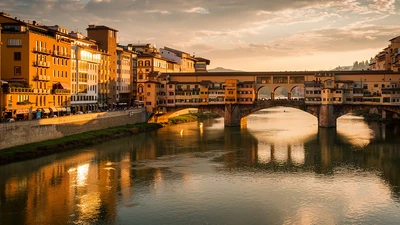
The 19th-century terrace on the south-bank hillside above the Arno, with the unbroken postcard panorama of central Florence: the Duomo, the Campanile, the Palazzo Vecchio's tower, the Ponte Vecchio, and the river running through them. Free, walkable from the Ponte Vecchio in 25 minutes uphill or accessible by the C3 minibus. Sunset is the obvious moment, and the small church of San Miniato al Monte just above the piazzale is the actual aesthetic peak — a 11th-century Romanesque facade with a working Benedictine community that sings vespers at 5:30 PM most days.
Food
Tuscan food is rustic and meat-heavy, the opposite of refined Italian Italian food. Things to eat in Florence:
- Bistecca alla fiorentina, the giant T-bone from Chianina cattle, charged by weight (a 1 kg steak feeds two), served rare
- Ribollita, the leftover-bread-and-bean winter soup
- Pappa al pomodoro, the leftover-bread-and-tomato summer soup
- Lampredotto, the slow-cooked stomach sandwich, a Florentine street food sold from carts at the Mercato Centrale and around Sant'Ambrogio
- Schiacciata, the flatbread stuffed with prosciutto and fresh cheese, the proper takeaway lunch
- Gelato — the modern version was invented in 16th-century Florence; Vivoli, Perché No, and Gelateria della Passera are the historic shops
Mercato Centrale at San Lorenzo is the food-hall version. Trattorias around Sant'Ambrogio market and in Oltrarno (the south bank) are the local-not-touristy version.
When to Visit
April through May and September through October are the best months. The summer crowds disappear, the Tuscan light is golden, the temperature stays in the 18 to 26 C range, and queues at the Uffizi and Accademia drop noticeably. July and August are the hottest and most crowded; expect 35 C and lines for everything. Winter (December to February) is mild, atmospheric, very low-tourist, and the best season if your priority is the museums and the food rather than the gardens.
Getting There
Florence Airport (Peretola) is 4 km from the center, with the Tramvia T2 line running directly into Santa Maria Novella station in 22 minutes. From Pisa Airport, the regional train runs in 1 hour; from Rome, the Frecciarossa fast train in 1 hour 25 minutes; from Milan, 1 hour 50 minutes. Florence is a perfect AVE high-speed-rail base for day trips into Tuscany — Pisa (1 hour), Siena (1.5 hours), and the Cinque Terre coast (2.5 hours) are all easy returns.
Accommodation
The historic center inside the walls is the most convenient base if your priority is walking to the museums; the streets around Santa Maria Novella station are well-served by transport and slightly cheaper. Oltrarno (south bank, around Santo Spirito and San Frediano) is more atmospheric, with Florentine artisan workshops still operating and a quieter dinner scene; you walk back across the Ponte Vecchio after dinner. Avoid hotels east of the Sant'Ambrogio market for first-time visitors — the area is fine but noticeably further from everything.